INTRO
I chose to specialise in sound for film because I am interested in creating scores for horror and avant guard films. Last year I looked into Angelo Badlementi’s score for the Series ‘Twin Peaks’ and particularly focused on how he improvises along side David Lynch’s description of the scene as i am interested in automatic processes. I enjoy how film brings all mediums together. I think film has had the deepest impact on me in terms of mediums as it can conjure a immersive experience using all senses at the same time as it combines all art forms. In my favourite films the camera itself is utilised as a tool for expression also. Sound is an extremely incremental aspect of film. Sound completely shapes film with life, emotion, tension etc even though its presence is not essential for it to work the lack of it or the silence is also extremely present and so it’s always considered.
I enjoy horror film sound tracks and scores as they create this idea of ordinary things becoming evil. For example in ‘The Shining’ (1980) the wheels of Danny’s tricycle along the corridors mixed with the rising shepherd tone becomes incredibly tense and haunting.
I appreciate how in film music can put you into someone else’s world that they’ve imagined and through seeing out their lens you feel you can see with utter clarity in your own life once again. like a breath of fresh air thats blown away everything thats become too constrictive and serious.
WEEK 1
PERPETRATION TASK/ A FILM THAT REFERENCES PLACE OR ENVIRONMENT

”28 Years Later is a 2025 post-apocalyptic horror film produced and directed by Danny Boyle and written by Alex Garland. The third in the 28 Days Later film series. The score is by ‘Young fathers’.
(synapsis)
It’s been almost three decades since the rage virus escaped from a biological weapons laboratory. Still living in a ruthlessly enforced quarantine, some have found ways to exist amid the infected. One such group of survivors lives on a small island connected to the mainland by a single, heavily defended causeway. When one of them decides to venture into the dark heart of the mainland, he soon discovers a mutation that has spread to not only the infected, but other survivors as well.
The quarenteen of Britain and the way that the rest of europe carries on with out potentially reflects Brexit and the political isolation Britain inflicted upon its self. The way the film flickers back to old war footage emphasizes how we remember history and culture and the idea of history as if it’s a mismatch of different accounts like whispers of the past or an amalgamation of everything that’s been left behind. And without the advancing of society what from the past would still remain? This film references place in the sample a 1915 reading of the poem ‘boots’ by Rudgard Kipling. The voice reading speaks at first in a monotone manner almost connecting words as if it’s the shipping forecast. As the poem goes on the voice gets louder and more shrill which invokes the sense of dread and unease. The War references are effective in predicting the gore to come, mirroring the gore and brutality of War. The stomping of the boots and rhythmic pattern of the words act like a ticking clock. The voice has a very well spoken english accent which is nostalgic as it was commonly heard in British tv and radio of the past. This film also references British culture using popular symbols such as the Queen and Jimmy Saville. its interesting that it shows how the split between the symbol and its context or environment can create a myth. It makes me think about how prophets and religions are born.
CLASS SESSION
Notes/
Elements of a soundtrack: NON SYNC – SYNC SOUNDS/ DIEGETIC/NON DIEGETIC off screen/on screen/ DIALOGUE/ SYNC/ ADR/ VOICEOVER/ ATMOSPHERES/ SOUND FX/ FOLEY/ MUSIC/ SOUND DESIGN
“We gestate in Sound and are born into sight. Cinema gestated in sight, and was born into
sound” (Chion. M 1994 Audio vision Columbia University Press, New York)
”As long as we can´t see whom we attribute all-seeing power to the voice, but once inscribed in the
visual field he loses his aura (as the wizard in the Wizard of Oz and HAL in 2001).”/slides
During week 1’s session we took Field recorders around the University recording short clips of sound from various sound objects around.
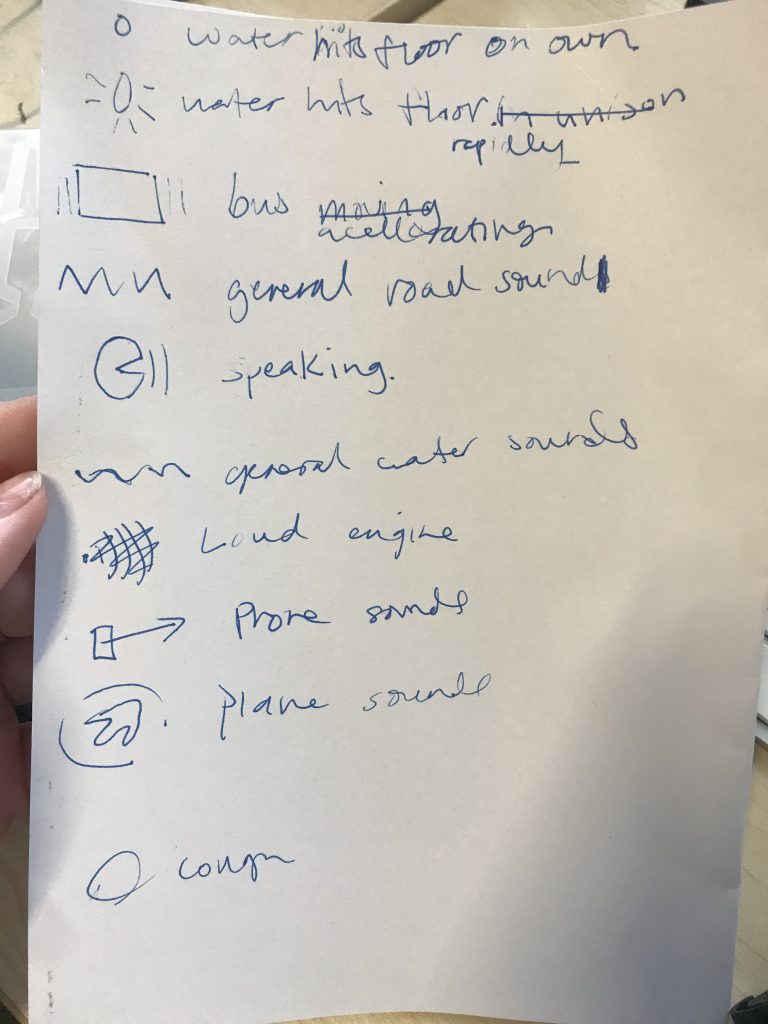
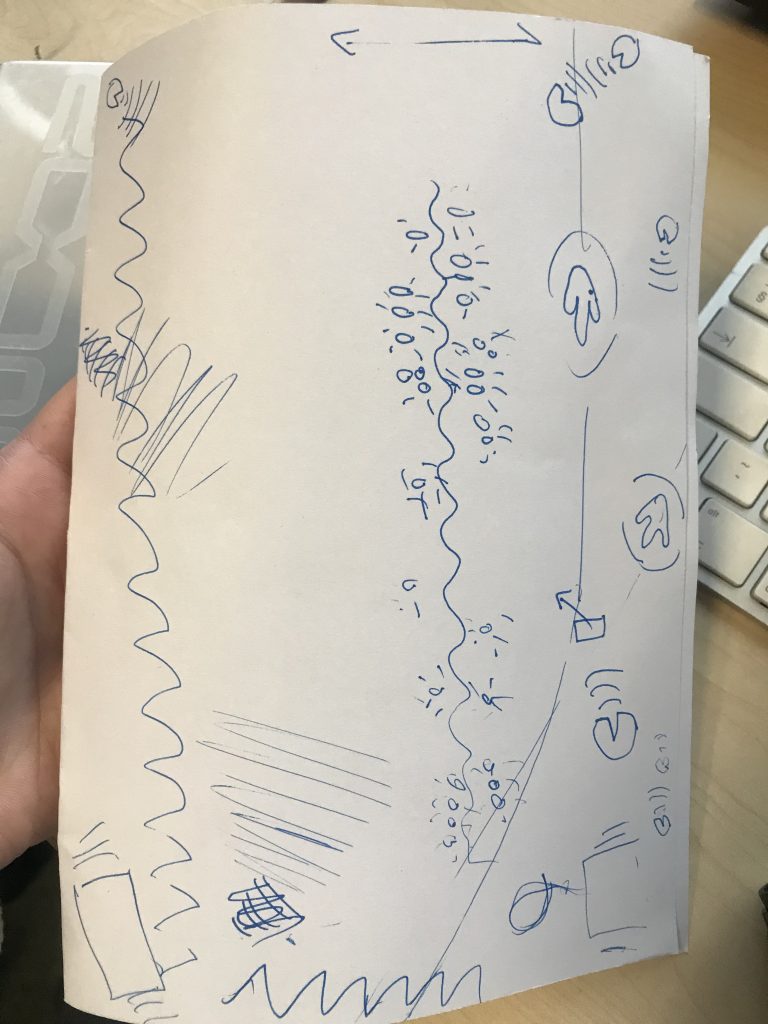
Then I sat at the fountain and drew a sound map. (As seen below)
WEEK 2
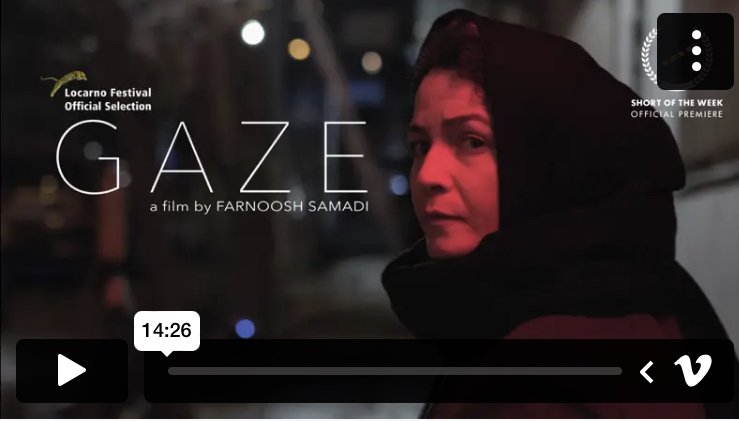
Gaze by Farnoosh Samadi is a short film which follows a lady who’s finishing a long shift at work and travelling home on the bus.
The camera follows the main character closely which entwines her perspective with the audience. When she’s on the bus she witnesses a crime and she struggles to decide whether to confess what she’s seen or keep her head down. This puts the audience in the same predicament and made me question my own morals; whether I would put myself in potential danger to do the good thing. There is no music in the film only diegetic sound however the lack of music allows the story to speak for itself and due to the nature of the story being a ‘whats she going to do next’ plot the lack of music allows each decision to unfold in realtime. We have no forecast of what she is thinking which directs the audience into their own heads, putting them in the place of the protagonist. What you think she’s going to do next reflects on your own experience instead of music or atmosphere to communicate her inner dialog .
Footsteps as the protagonist walks along the hallway towards you (the viewer)
It’s a nice introduction her image is reflected in the shiny floors of the hallway possibly referring to the upcoming introspection the film places her and the audience in. The sound of the approaching footsteps is a way to introduce the character without much information being shared. The gradual sound of the footsteps advancing let’s you know this is going to be the main character entering. Although she’s walking towards the camera she still does not make eye contact, her gaze looks from side to side or down. You feel she may walkthrough you and continue down the hallway but just before she does she enters a side door. I feel this reflects the way we are so close to her and see everything she’s doing yet never can know what she’s thinking, we can only guess. We also don’t know her name, it’s as if we are really just following a stranger home. We’re holding out for any information we can gather on her as the story plays out in order to understand where it’s leading. This boundary is shown by the way we expect her to walk up to us but she exists through the door instead. Similarly later in the film we expect her to not say anything as she waits till the last possible moment to come forward with the information. The sound of the bus stopping and the hissing pressure of air that’s released matches the release in tension when she comes forward.
The story follows a working single mother living in Iran which is a perspective not often highlighted. She has to deal with intimidation on public transport and she worriedly looks over her shoulder as she paces home. she rejects the offer of the bus driver to not cause a fuss, somethings lots of women may relate to. The film comments on gender and class inequality. Through sharing this story the viewer will either relate and feel their experience validated or their eyes will be opened to their own privileges in society. The film is very subtle in the way that no real physical damage is ever done however this reflects the daily unease and paranoia felt by women particularly in countries that sees them as less than men. This film made me reflect upon my own experience as well as acknowledge my own privilege. I feel in the UK although we still live under patriarchy it’s more subtle and we are not out-rightly told women are less then men now days. However it’s very much realised in statistics for femicide , sexual violence, the pay gap, lack of healthcare research and lack of representation in senior positions etc.
QUESTION/ WHAT IS POV AND WHO IS TELLING THE STORY?
POV is who’s perspective the story is shown through. For example ‘Gaze’ is told from the POV of the Lady commuting home. You could say this film uses the ‘female gaze’ as the viewer is transported into the complicated and unique emotional journey of the protagonist. Whereas in ,for example, the James Bond films the Women are seen through the lens of patriarchy where they are objectified and sexualised like a prop with the purpose of enriching the world of the male protagonist.
The Male Gaze is problematic as it reinforces and maintains patriarchy and the objectification of Women, leading to harm and violence being inflicted upon women in real life.
The same can be said for the White Gaze as it protects harmful stereotypes of people of colour and supports and protects White dominance and therefore leads to violence. The White Gaze assumes that the audience is white or will put themselves in the position of white person ignoring racism, prejudice, colonialism and slavery.
”Until we are able to look at the ways in which white Americans are culpable in the suffering of the people of colour, and understand that culpability needs to be present in the representation of that, suffering will continue.” – Claudia Rankine
The White Gaze views the story through the perspective of white dominance. ”A concept whereby white people resist inclusion in a racialized category yet render people of colour as representatives of racialized groups. ” – Dani Snyder-Young
‘It reads the non-white as a threat while overlooking its own position of power’- Judith Butler
WEEK 3
NOTES/ ‘WE NEED TO TALK ABOUT KEVIN‘dir. Lynne Ramsay 2011
The film uses non-diagetic sound to mirror the emotions of the Mother who is the main protagonist and communicates and emphasizes the tension between her and the son as the film continues. The non-diagetic tension music usually cuts out when someone else enters the room. This reflects that the tension is invisible to anyone but her and him and isn’t ever fully acknowledged through dialog therefore is communicated through sound. This unspoken discomfort I believe is what leads to the eventual climax. The sound of the sprinkler is flipped from the original symbol of a middle class suburban ‘dream life’ to be a sinister indicator of the gore to come. the sprinkler sound loosely mimics the music from the infamous shower scene in ‘Psycho’ (1960) and this symbolizes the reveal at the ending of the film.
CLASS SESSION
In this session we used the studio and foley room to record the Foley Sound for the opening scene of the film ‘We need to talk about Kevin’ (2011). Firstly i opened Pro tools and burnt in the time code. We then set up appropriate microphones. We used shotgun mics to record footsteps changing between different shoes and surfaces in correspondence with what was happening live in the visual. We used condenser mics to record the high frequency sound of the clothes moving. I found this helpful to observe how to preform foley live to the visual. I also took part in preforming the footsteps however i wasn’t very good at being in sync.
WEEK 4
‘A Ritual In Transfigured Time’ (1946) By Maya Deren
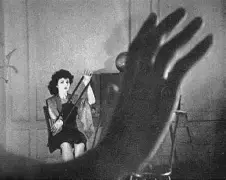
The film clip I’ve chosen to use for this project is from the film ‘A Ritual in transfigured Time’ (1946) By Maya Deren. I chose this film as i am largely interested in Dance and film and i also enjoy the theme of rituals as a way of transferring/transforming energy or harnessing it. I also enjoy the visual aesthetic and the Avant-garde, experimental style of the film. The films duration is 15 minutes and so I will have to cut it down into one single scene to fit the brief. I will struggle to pick which scene as each one moves into the next so seamlessly.
A Ritual In Transfigured Time'(1946) explores social interaction as Ritual. The wool ritual in the film could link to the witches cradle as witch craft was something Deren was interested in. She has another film called ‘The Witches Cradle’ 1943 which she made with M Duchamp.
The film centres a female protagonist but also because of the nonlinear form of the films as well as the symbols shown the film feels as though it belongs to a woman’s perspective. In Ritual in Transfigured time Rita Christiani, who plays the protagonist, appears in a nuns outfit with a black veil signifying her as a widow and then at the end when the image is reversed the veil is white and she is a bride. This could refer to The ‘Sacred marriage’ which in Alchemy refers to when the opposites inside ourselves are integrated causing spiritual transformation and enlightenment.
I became interested in Maya Deren last year. She is a dancer and choreographer as well as film maker and theorist. She was born in Ukraine’s capital the year the Russian revolution began to a Jewish family but moved at 5 years old to New York. Both her parents were highly educated. Her father was a psychiatrist and she was raised in a socialist household.
She was given the name Maya by her second husband the film maker Alexander ‘Sasha’ Hamid after the Mother Buddha ‘Godess of the Veil’.
You cannot talk about Maya Deren without talking about Katherine Dunham who Deren was an assistant to and then editor for. Katherine Dunham is known as the ‘Queen Mother of Black Dance’. She had her own dance company which toured globally. Dunham is an extremely influential dancer; anthropologist; choreographer; activist and Humanitarian. The company showcased performances that blended African, Caribbean and south African dance with modern ballet techniques. This popularised African American dance and created the Dunham Technique.
”Dunham was a pioneering anthropologist and choreographer who deeply engaged with Haitian Vodou through her ethnographic research, which began in 1936. Her work not only studied but also incorporated the spiritual and dance practices of Vodou into her own artistic style, leading to her initiation into the religion and the creation of her book Island Possessed. She saw the practice as a way to understand a complex and nuanced form of diasporic black identity beyond simplistic notions of “primitivism”.
Katherine Dunham introduced Deren to Haitian Vodoun as Maya Deren edited her paper “The Dances of Haiti: A Study of Their Material Aspect, Organization, Form, and Function”
‘Talking about her film Meshes of the Afternoon, she stated that she was interested in the credibility of the unreal, not the incredibility of the unreal. “I am concerned,” she wrote, “with that point of contact between the real and the unreal, where the unreal manifests itself in reality.’
Her intense appreciation and involvement in Hatian Vodoun can be understood as it is a culture that gives credibility to the ‘real’ and ‘unreal’. Whereas the Western surrealist movement she believed had clear divisions between the ‘real and ‘unreal’ and she denied any connection with its aims. She recieved a Guggenheim Fellowship in 1946 to make a film on dance in Haiti but onve she was there she felt she had to abandon the project as she felt she needed to be immered in the culture taking part learining not observing and documenting behind the camera. People were surprised how she was welcomed by the Haitians as a white woman coming over to learn about black culture however she gathered so much information and became so involved she wrote the book ‘The Divine Horsemen of Haiti’ She was initiated into the religion took part in rituals and it became a huge part of her life, ideals and artistic practice.
Controversially She became affiliated romantically with the 15 year old Japanese composer Teji Ito when she was in her 30s. She then Married him in 1960 when he was 24 and she was 43 and they remained married until her death a year later. Ito composed the scores to ‘many of her films and after her death relased the footage which she had filmed in Haiti.’Ameditation On Violence’ 1949 and made an OST to ‘Meshes of the Afternoon’ the year before she died. After she died he released the footage from when she was in Haiti.
She died of a brain haemorrhage at age 44 in 1960. She had become addicted to Methadone which she was being prescribed by her doctor. Strangely this was the same Doctor proscribing JFK and other celebrities at the time. She was also poor and could barely afford to feed her cats which could have contributed to her being unwell. Some believe she was cursed and others that she was possessed and this was the reason for her early death.
Deren’s films have little separation between time, space reality and non reality. Using techniques such as freeze frames, jump cuts etc she portrays dancers spinning through time and space, dancing from scene to scene not defining what is ‘dream’ from what isn’t, it becomes one full experience. She uses camera techniques to exploit the full artistry of cinema and this was something she consciously sought after. She believed current cinema was uninspired and relied too heavily on literature/story/script and the actual art of cinema as a medium was becoming lost or not used to it’s full potential.
bibliography
‘One must at least begin with the body feeling’: Dance as filmmaking in Maya Deren’s choreocinema
‘In the Mirror of Maya Deren’ Documentory (2001)
WEEK 5
I ran into a creative wall when trying to pick which section to use from the film ‘A Ritual in Transfigured time’ Maya Deren (1946). I feel that each section accompanies the next so well, giving point and rhythm to it all, that isolating one part doesn’t have the same unexpectedness and excitement of the film in whole which allows less scope for the sound. Shortening an already short film feels wrong and i don’t have the same enthusiasm about creating the sound. I also feel that as the film is intended to be silent and the visual is so strong that the music and sound doesn’t feel it could add to the experience in an enriching way. On YouTube i was able to find many recent original compositions made for the films and although they are executed well i found some slightly distracting or jarring as i could tell that the sound didn’t belong on the film originally. the music felt too modern yet was imitating oldness through style and effect; it lacked the warmth, warp and stillness that is present in music from that time (40’s/50’s). The film felt it was drowning in music that didn’t definitely correlate. It lacked space and silence which would have matched the space, stillness and surreal emptiness of the visual. It’s as if they didn’t belong in the same world and one takes you away from the other.
I didn’t consider originally how i would make sure that the music/sound would feel that they belonged in the same time as the film or whether this was important to me.
I was thinking about using tape to record te music and i think i will experiment with this idea however i dont wan the process of doing this to take over the entire project and create distance from what im trying to get done. I also dont see the point in re-amping the finished peice through the tape machine at the end as this is just immitating the feeling of oldness without it actually effecting my process. I will se how this works out when i start recording.
I feel i should address the experimental nature of the film by looking at the sound through this same lens. I believe initially i will improvise whilst watching the clip, reacting to the movement in the clip. This will help me become open to the structure and start the process of creating an idea or things to lead off of. I don’t think i will use foley or diagetic sound instead replace the sounds of what one would expect such as the sound of coiling of thread with what i imagine this could sound or feel like in this altered world that Deren has created. For example this thread coiling motion seen in the film could be represented with the sound of tightening the lid of a bottle. I was hinking about attaching specific sounds to each character of movement to create a kind of language. This will be an experiment to whether this is communicated or has any effect when listening however i think it could be an interesting idea in relation to the ritual aspect of the film. I want the sound to have the same rules applied to it as the visual so i will be thinking about ritual throughout the process.
WEEK 6
‘Teapot Apple 2 Cue houses atomic bomb effects’ (1955)
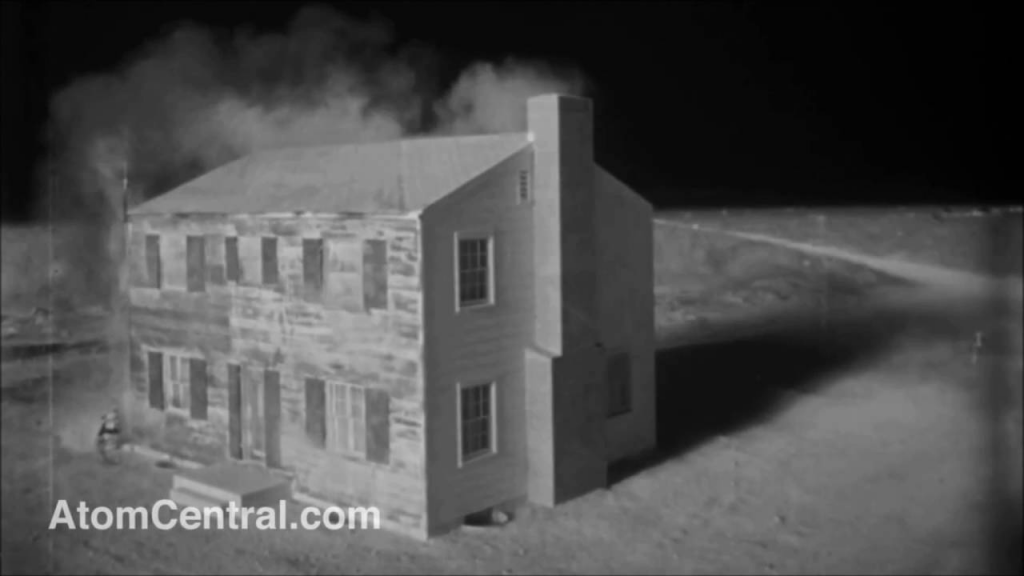
I have come across another clip I would be interested in using for this project: ”Teapot Apple 2 Cue houses atomic bomb effects’found on the YouTube channel AtomCentral.com.
Clip description via YouTube:
”The following clips were from an atomic test known as Teapot Apple 2 and Operation Cue which took place on May 5, 1955. Project 39.4c provided remotely operated photographic coverage of blast and thermal damage to physical structures. Apple 2 was a 29 Kiloton nuclear test. A total of 48 cameras were operated at distances from ground zero of from 2750 ft to 10,500 ft. These particular clips were photographed both inside and outside of the houses at distances ranging from 4700′, 5500′, 7800′ and 10500′ from Ground Zero. They have been cleaned up for the most part with sound effects added. May 2015 will mark the 60th Anniversary of these historic and iconic images. This material is available for licensing in high resolution 2K and HD.”
USEFUL LINK/moreinfo : Fact
‘Operation Teapot’ was a series of 14 nuclear test explosions tested in America’s ‘Nevada Test site’ in May 1955. It was the 11th series of nuclear tests ever done conducted by the Atomic Energy Commission (AEC).
It was done with the purpose of testing nuclear devices
for possible inclusion in the weapons arsenal; to improve military tactics, equipment, and training; and study civil
defense requirement.
The footage is for archive and documentation purposes although the clip has been ‘cleaned up’ and sound effects have been added. I’m unsure for what reason but i assume for public viewing purposes. Although these are just documentation of experimental tests the video is very cinematically interesting. The way some shots are framed with a black edge as if your looking through a telescope due to the cameras having to have heavy duty protection distorting the image; The flash of light then the way the dust is sucked out then into the building.
I would like to explore the topic of self destruction in this project. I will do this by recording myself destroying different items e.g. smashing up a chair with a sledge hammer; throwing cups, plates, sauce-pans … down the stairs. Tearing up books etc etc. I will objectify myself in this applying the patriarchal notion that a woman is a domestic object (although this is not the main or only point). The point is that the house is destroying its-self and therefore i am part of the house. The sound will not sync with the visual however it will follow the pacing and respond. In the moments of silence before the explosions i am thinking about using the sound of some kind of bell or gong type instrument. My idea was to use an instrument traditionally used to create a meditative frequency so that the audience is lulled in and out of comfort and discomfort.
WEEK 7
I have decided to revert back to my original idea using the clip from ‘A Ritual In Transfigured Time’ As i feel for this project it will fit the brief more closely.
The extract i have chosen to use is the first 4 mins and 50 seconds. In this clip the the Wool ritual takes place and then the last scene is Christiani wearing the black veil. I will find it interesting discovering the sounds of this ritual. I originally thought i would not use diegetic sound however i believe this could be interesting to try and preform the ritual myself and record this for the sound as an experiment.
I started this composition improvising to the visual hitting notes using a small pan drum type instrument which i’m unsure of the name of and am unable to find.
I then cut the initial impact sound and left the resonating tone I then reversed this to create a hypnotic sound.
Deren uses amateur aesthetics and processes in her work as this meant her process was more immediate and she was able to experiment with different ideas and techniques. She thought it was important that the budget of a film did not effect its risk taking. The higher the budget of a film the more pressure for it to satisfy audiences and therefore what tends to happen is less risk taking. She thought of film as the way in which to transform time and had nothing to do with commerciality. This is something that draws me to her work as she is able to create these illusions without expensive studios. I will apply this same strategy to the composition by using what i have and by being experimental with my approach.
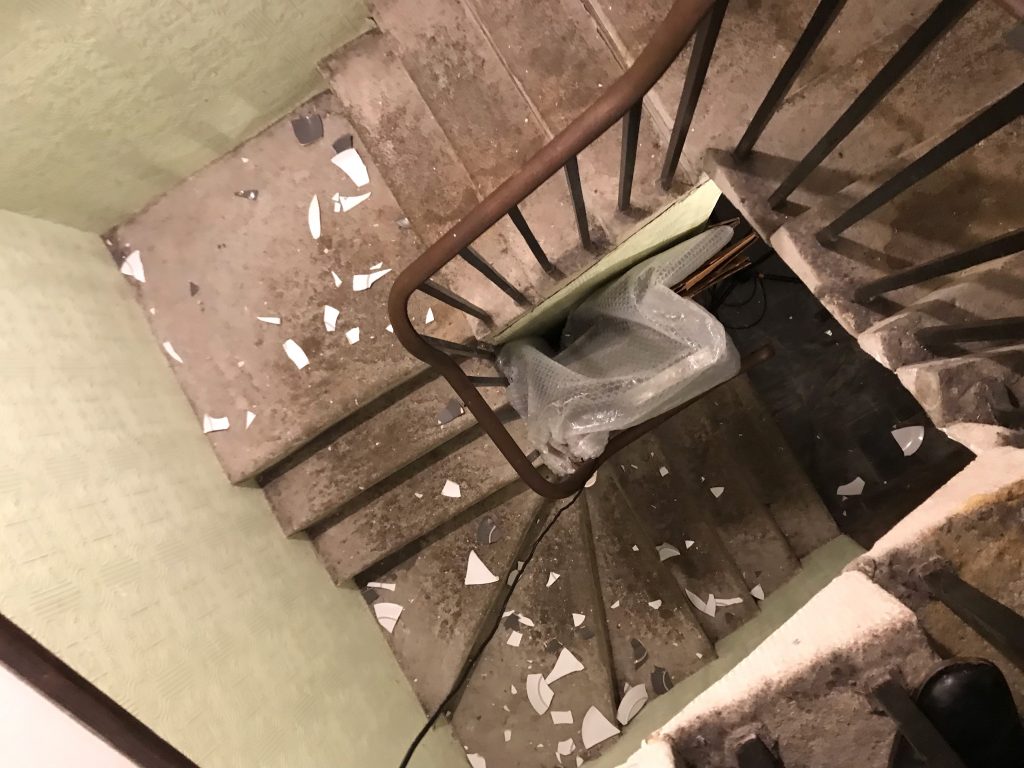
I decided to record myself throwing plates down a stair well. This was a ritual in itself. I find the idea of the movement of this exciting and the energy it will create. I think the sound of the recording will hold some of this energy and preserve it. This Ritual for me will be about breaking something and letting it go but with purpose and intention.
For this ritual i will stand at the landing with my stack of seven ceramic plates. i will place one pencil condenser microphone at the half way mark and another at the bottom of the stairs so that it sounds like a vacuum like the sounds being sucked down as i think this will be interesting effect. I will then call the plate number wait 3 seconds and drop the plate down the stairs. The stairs are concrete. In the first test i will only drop the plate from my hand and then as the ritual continues I will increase the strength i use to let go of the plate and by the seventh plate i will be throwing it down the stair case.
WEEK 8
I will be using Logic pro X to mix and master. I have cut most the silent spaces out of the Steel drum chime clips and arranged them into a sequence which i will play in a section of the film.
I Then have recorded singular symbol hits. I then eq these cut out the best bits and reversed them.
Next I recorded myself playing the penny whistle and also reversed some bits and time stretched it to make it slower and faster in different places.
For atmosphere I used the steel drum and gently brushed it in circular motions to create a continuous but fluctuating sound which i will fade in and out.
After that i took the smashing plate recordings i also reversed some of these, time streched and i may add other effects to manipulate the sound.
So far i think i will work with this sound board and see what i can do. I think i will add a melodic element during the scene when she starts going into slow motion. I think i want to record this on a real piano instead of my midi keyboard for a warmer sound.
I may also incorporate my voice, not with words but to add depth to some sounds.
WEEK 9
I decided to watch some films as i thought this would be a good last peice of research before i started to put togther the score.
I think its useful that the film is originally silent as it gives me more creative freedom to work from a blank slate.
I decided to watch the Shining and take notes on the sound. From this i decided i wanted to add a melodic element in order to create ambience and bring the sounds together and create a bed for it to sit on.
I also recorded some more sounds to add. I used crisp packets and placed my microphone inside. I then used to flex tool on Logic and changed it to polyphonic to time stretch the files and distort them.

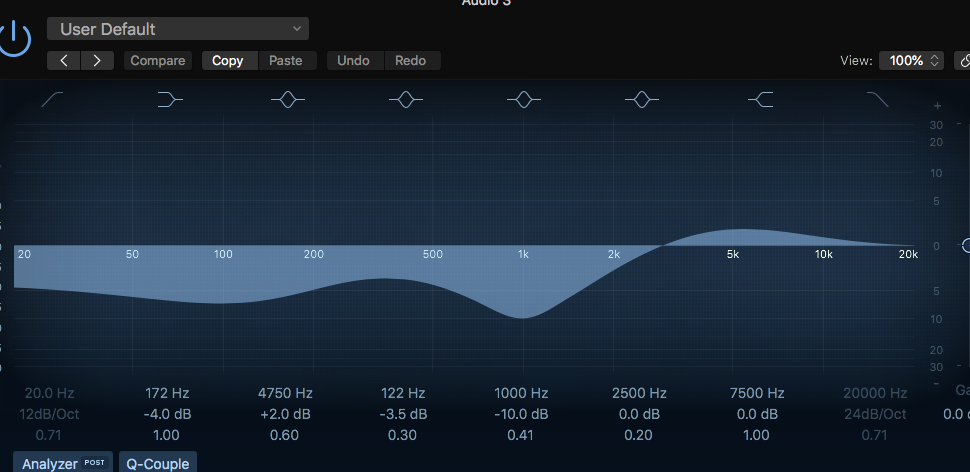
I used the EQ tool on each audio-file and put a highpass filter to cut out some of the background noise and make the sound more compressed. And equally the alternative if there was unwanted low frequency sounds.
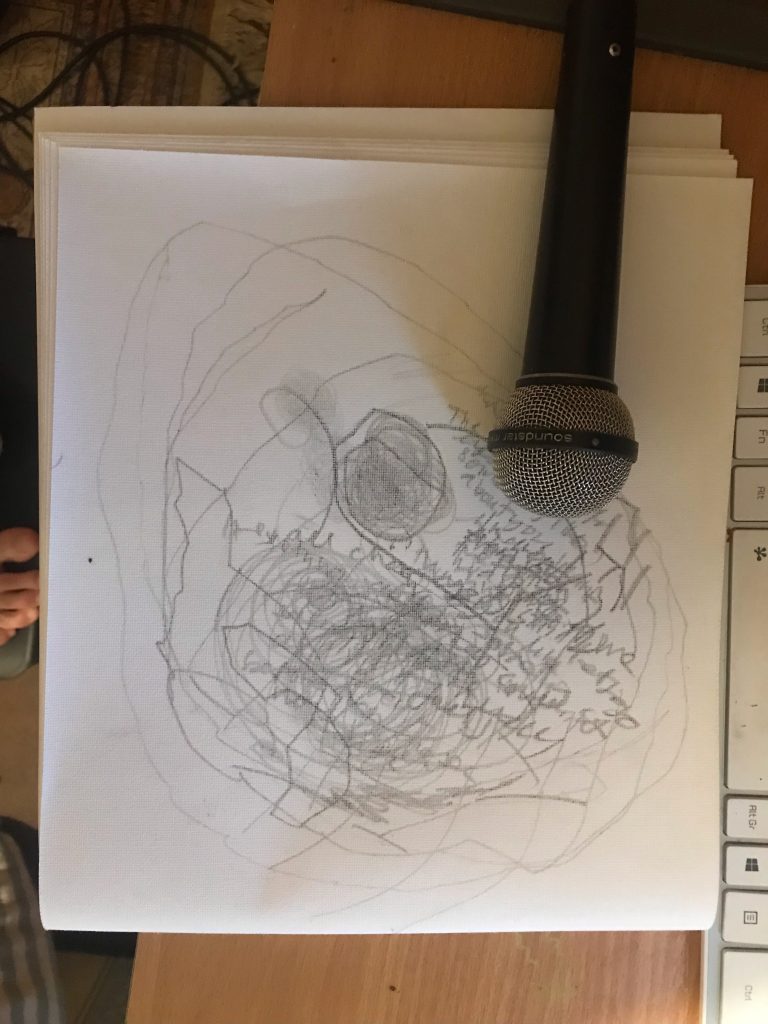
I then completed anther ritual where i did four takes writing automatically to the visual on paper. I rested the Microphone on the table and took some textured paper. I then recorded four takes. I the first take I drew a spiral increasing gaining more momentum as it went outwards. For the second i drew the same spiral inward. For the third I wrote automatically and for the fourth I responded to the other three. I then altered these with reversing and time stretching and EQ.
I also recorded ripping fabric but i don’t think i will use this as the sound wasn’t what i expected and i don think this will fit.
too add more atmosphere i took an empty plastic bottle and moved it around the microphone. I then warped the audio file witht the flex tool.
WEEK 10
Studio session – Mixing Mastering
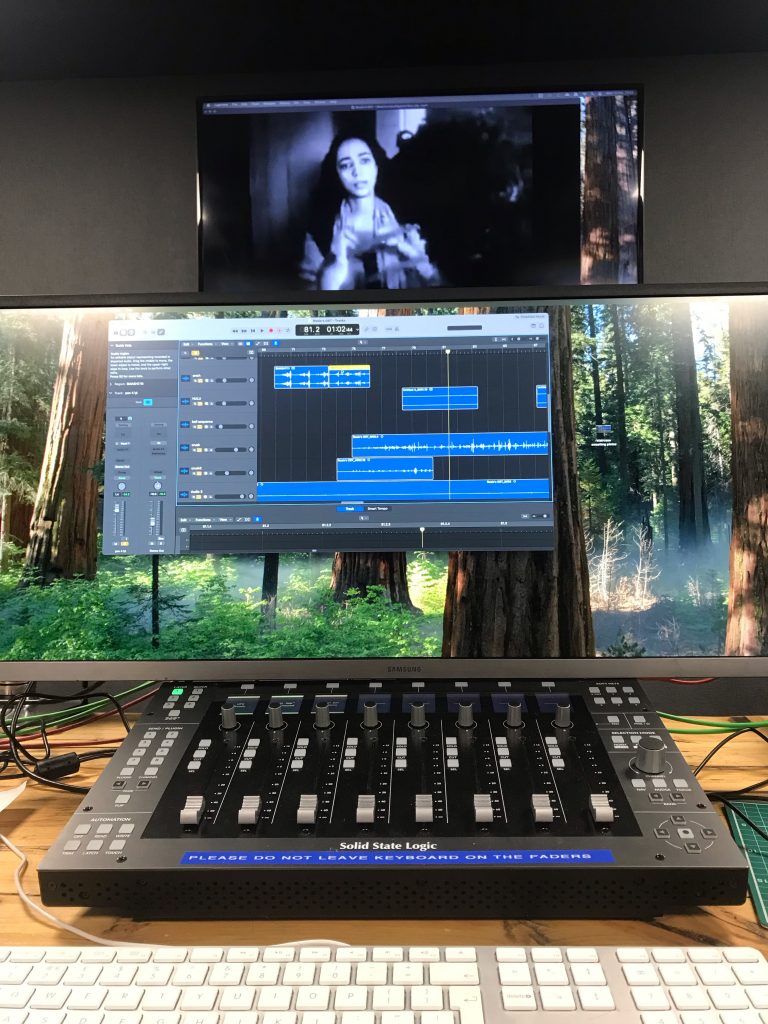
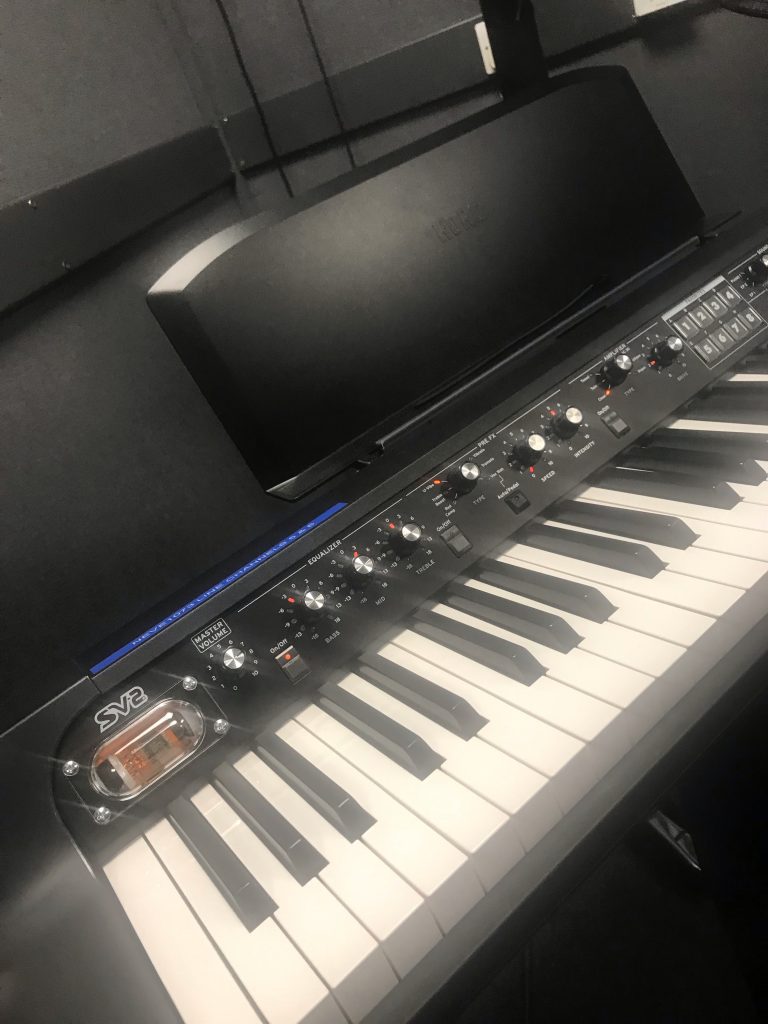
I booked the Comp Studio in order to mix the final piece. I also wanted to use the KORG synth to add a melodic element through out in order to bring everything together.
I found it useful having the split screen and being able to listen through the professional speakers to pick up faults.
Using the split screen i was able to improvise the melodic part to the visual which i am happy with.
Unfortunately after arriving home i found the project i had been working on in the studio had corrupted so i’m unsure if i will be able to use this in the final piece unless i can work out how to retrieve the file in time.
I will us premier to put the audio and visual together.
Leave a Reply